Gentle Bon Ami or powerhouse Bar Keepers Friend— which powder truly conquers grime and which one could cost you your cookware?
Surprising fact: two humble powder cleansers can revive stainless steel and grout—Bar Keepers Friend and Bon Ami. This head-to-head helps you pick by comparing cleaning power, surface compatibility, safety, price, scent, and real-world user tips for kitchen and bath today.
Tough Stains
8.8
A high-performance powder cleanser that consistently removes tough stains and rust while restoring shine to metal and porcelain. Best suited for heavy-duty cleaning tasks where strong stain removal is required, though care is needed on delicate finishes.
Gentle Cleaner
8
A mild, all-natural powder cleanser ideal for routine cleaning and surfaces that need a gentler touch. It excels at upkeep and delicate jobs but is not the first choice for severe rust or heavily baked-on residues.
Bar Keepers Friend
Cleaning Power
9.4
Surface Safety
8.4
Ease of Use
8.7
Value for Money
8.7
Bon Ami Cleanser
Cleaning Power
7.5
Surface Safety
9
Ease of Use
8
Value for Money
7.5
Bar Keepers Friend
Pros
Extremely effective on rust, baked-on grime and hard water stains
Works on a wide range of surfaces including stainless steel and porcelain
Concentrated powder—small amount goes a long way
Trusted, well-documented formula with many positive user experiences
Bon Ami Cleanser
Pros
Gentle, all-natural formulation suitable for delicate surfaces
Non-bleach powder that tackles everyday stains without harsh chemistry
Good for regular upkeep and safe on many finishes
Bar Keepers Friend
Cons
Contains stronger active ingredients (use cautiously on delicate or unsealed surfaces)
Can be slightly abrasive if used with harsh scrubbing pads
Bon Ami Cleanser
Cons
Less aggressive on heavy rust and baked-on grime compared with stronger cleaners
May require more elbow grease or repeats for very stubborn stains
1
Formulation & Ingredients: What’s Inside?
Bar Keepers Friend (Powder)
Bar Keepers Friend powder uses oxalic acid as its primary active plus fine mineral abrasives. The acidic chemistry chemically dissolves rust and mineral deposits while the abrasive particles help scour away baked-on grime.
Scratch risk: low-to-moderate on hard surfaces; higher risk on soft or unsealed materials
Bon Ami (All‑Natural Powder)
Bon Ami is built around mineral abrasives — a feldspar/limestone-style blend — and is marketed as an all‑natural, non‑bleach powder. It relies mainly on mechanical scrubbing rather than strong acids.
Active: mineral abrasives (feldspar/limestone)
Chemical action: non-acidic, no bleach
Typical scent/additives: generally fragrance- and dye-free
pH: near-neutral to mildly alkaline
Scratch risk: lower, designed for delicate finishes
How ingredients drive performance and safety
Oxalic acid gives Bar Keepers Friend superior chemical action on rust and hard-water scale; abrasives boost immediate scrubbing power. Bon Ami’s milder minerals perform well for routine cleaning and delicate surfaces but may need more elbow grease on heavy rust or baked-on grime.
Toxicity & precautions: oxalic acid is toxic if ingested and can irritate skin/eyes; Bon Ami is less chemically hazardous but still abrasive.
Mixing warnings: never mix Bar Keepers Friend (oxalic acid) with bleach or ammonia — hazardous gases can form.
User safety: wear gloves, avoid eye contact, rinse thoroughly, and ventilate when using either product.
Bar Keepers Friend (BKF) wins here. Oxalic acid chemically dissolves rust and mineral scale, often removing spots in one application with light scrubbing. Expect visible improvement within 1–3 minutes; stubborn scale may need a second 5–10 minute paste application. Bon Ami will scrub away light mineral haze but usually requires longer scrubbing and repeats.
Baked‑on food & carbonized grease
BKF removes carbonized grease faster — apply as a wet paste, let sit 5–10 minutes, scrub with a non‑scratch pad and rinse. For heavily burnt pans, multiple short applications beat one long scrub. Bon Ami lifts lighter baked‑on grime with vigorous scrubbing; it’s slower but safer on some cookware finishes.
Tarnish & metal polishing
BKF often removes oxidation and restores shine on stainless and some brass; use gently on softer metals. Bon Ami polishes more gently and is less likely to dull delicate finishes, but it won’t chemically remove deep oxidation as quickly.
Bathtub/porcelain soap scum
Both work well. BKF clears mineral-heavy buildup faster; Bon Ami removes surface soap scum with steady scrubbing. For heavy scale, expect 5–10 minutes with BKF paste; for routine cleaning, Bon Ami is adequate.
Glass & mirrored surfaces
Bon Ami leaves less chemical residue risk on glass and mirrors; use a damp microfiber after scrubbing to avoid streaks. BKF can be used but rinse thoroughly to prevent hazing.
Application, time‑to‑clean, and repeats
Method: make a wet paste for tougher jobs; sprinkle dry for light dusting.
Tools: soft pad, non‑scratch scrubber, or microfiber for final wipe.
Timing: BKF — 1–10 minutes depending on soil; Bon Ami — immediate scrubbing, repeat as needed.
Repeat: stubborn stains may need 2–3 applications; stop if surface shows wear.
For heavy‑duty rust, baked‑on grime, or mineral scale choose BKF. For routine upkeep and delicate finishes, Bon Ami is the gentler, adequate option.
Feature Comparison
Bar Keepers Friend vs. Bon Ami Cleanser
VS
Formulation
Powder cleanser with oxalate-based stain removers
VS
All-natural powder with mineral abrasive (feldspar-based)
Primary Use
Heavy-duty stain & rust removal; kitchen and bath
VS
Everyday kitchen and bath cleaning; gentle stain removal
Abrasiveness Level
Medium (effective on baked-on grime)
VS
Mild (designed for delicate surfaces)
Safe On Surfaces
Stainless steel, porcelain, ceramic, glass; avoid unsealed stone
VS
Porcelain, glass, cookware, chrome; safe for many delicate finishes
Scent
Mild chemical/clean scent
VS
Subtle clean/natural scent or fragrance-free
Available Package Sizes
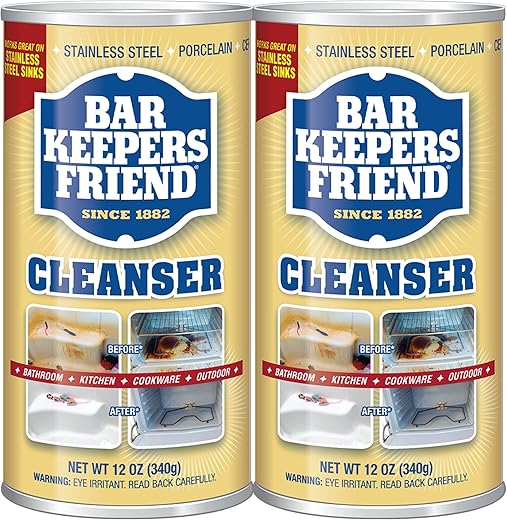
2 x 12 oz (this listing); other sizes available
VS
14 oz (this listing); other sizes may be available
Typical Price
$$
VS
$
Eco-Friendly / Natural
Not marketed as all-natural; contains stronger active ingredients
VS
Marketed as all-natural and biodegradable
Best For
Tough rust, hard water deposits, baked-on food, metal polish-up
VS
Routine cleaning, light stains, delicate finishes and upkeep
Active Ingredient
Oxalate-based cleaning agents (acidic components)
VS
Feldspar mineral abrasive and mild cleaners (no bleach)
Finish
Leaves metals and porcelain bright when used correctly
VS
Gentle, non-scratch finish suitable for frequent use
3
Surface Compatibility & Safety: What Surfaces Each Excels On
Quick compatibility roundup
Bar Keepers Friend and Bon Ami both clean common kitchen and bath surfaces well, but their chemistry and abrasiveness differ.
Bar Keepers Friend — safe and recommended for:
Stainless steel
Porcelain
Ceramic tile
Enamel
Chrome
Bar Keepers Friend cautions:
Contains oxalic/acidic ingredients that make it excellent on rust but risky on porous natural stone (marble, granite), some painted or lacquered finishes, and highly polished or soft surfaces—avoid these or spot-test first.
Bon Ami — safe and recommended for:
Stainless steel
Porcelain
Ceramic tile
Enamel
Chrome
Bon Ami cautions:
Gentler mineral abrasives are better for softer surfaces, antiques, and routine upkeep, but still avoid using on highly polished or easily scratched finishes without testing.
Special cases & cookware
Aluminum and anodized aluminum: BKF can dull or alter finish; test a small hidden area first. Bon Ami is usually gentler but still test.
Copper and bronze: Both can react differently—do a test spot and rinse promptly.
Cookware: Always follow manufacturer guidance (nonstick, cast iron, aluminum anodized). BKF can be used on some cookware but avoid long scrubs on nonstick or delicate coatings.
Safety tips (always follow)
Always spot-test in an inconspicuous area before full use.
Wear gloves and avoid prolonged skin contact.
Rinse surfaces thoroughly after cleaning.
Never mix either powder with bleach, ammonia, or other chemicals.
Work in a well-ventilated area to avoid inhaling dust or fumes.
4
Price, Packaging, Scent, and User Experience
Cost per ounce & household yield
Bar Keepers Friend (2 × 12 oz = 24 oz, approx $8): $8 ÷ 24 oz ≈ $0.33/oz
Bon Ami (14 oz, approx $7): $7 ÷ 14 oz = $0.50/oz
Using a typical cleaning dose of about 1 teaspoon (≈0.17 oz) per task:
BKF: 24 oz ÷ 0.17 oz ≈ 140 light-cleaning uses
Bon Ami: 14 oz ÷ 0.17 oz ≈ 82 light-cleaning uses
Smaller pinches for quick spot-cleaning increase yield substantially.
Packaging & texture
Bar Keepers Friend: Usually sold in smaller plastic bottles (twin 12 oz) with shaker-style tops — easy control, less waste, good for targeting stains. Powder is relatively fine and disperses readily into a paste.
Bon Ami: Packaged in a larger 14 oz can (often cardboard/canister with shaker) — solid value per container but a bit more awkward to handle. Texture is slightly coarser, mineral-feel, better for gentle abrasion.
Dissolvability, rinseability & residue
BKF: Dissolves quickly into a paste; rinses clean when wiped and rinsed thoroughly, but can leave faint residue if not fully rinsed.
Bon Ami: Slower-to-dissolve, may require more scrubbing on stubborn spots; generally rinses away with minimal residue.
Scent & user experience
Scent: Bon Ami is marketed fragrance-free/natural. Bar Keepers Friend has a faint chemical/acidic scent from its active agents.
Reviews & practical notes: Users praise BKF for faster results on rust and baked-on grime; many recommend gloves and spot-tests. Bon Ami is favored by customers with delicate surfaces, antiques, or eco-concerns. Both powders store well if kept dry; eco-minded buyers often prefer Bon Ami’s simpler ingredient positioning, while power-cleaning buyers pick BKF for performance.
Final Verdict: Which Cleaner Should You Buy?
Bar Keepers Friend is the clear overall winner for most households, choose it when you need powerful rust, mineral stain and heavy duty cleaning on durable finishes (stainless steel, porcelain, ceramic). Bon Ami wins when you want a gentler, more natural abrasive for routine cleaning, polishing or delicate surfaces (copper, painted surfaces, soft metals).
If possible, keep both: BKF for tough jobs and Bon Ami for everyday maintenance. Always spot test, follow label instructions, wear gloves when required, and compare cost per use against your surface priorities. Buy BKF for tough jobs and Bon Ami for delicate ones. Keep both handy. Happy cleaning.
45 thoughts on “Bar Keepers Friend vs Bon Ami: Stain & Surface Showdown”
James O'Neill
Quick note for porcelain lovers: both work but use softer application for BKF. For a really dingy tub, BKF removed years of soap scum in under 10 minutes.
Bon Ami was kinder to the finish but required more elbow grease.
Tried both. BKF = nuclear option for rust. Bon Ami = spa treatment for grandma’s china.
I keep a tiny jar of Bon Ami in the guest bathroom just in case someone drags in toothpaste stains.
Also, pro tip: small circular motions, less pressure, works wonders.
Bon Ami surprised me — gentle but effective. I have an old enamel sink and BKF took off some of the gloss before I learned the hard way.
Bon Ami cleaned it without that icky etched look. Also it smells way less chemical, if that matters to you.
Technical angle: BKF contains oxalic/oxalic acid derivatives that really target iron/rust stains, which is why it outperforms Bon Ami on rust.
Bon Ami is mostly feldspar and milder abrasives that scrub without cracking finishes. So pick based on stain chemistry, not just brand hype.
Huge fan of Bar Keepers Friend here. It ripped rust out of my kettle that I thought was gonzo.
I use it on stainless steel pans and my gas range — a little water, scrub, rinse, done.
Heads up: it can be a bit dusty when you pour the powder, and you should wear gloves if you have sensitive skin.
But for stubborn stains and rust? Nothing I’ve tried beats it for speed.
Thanks for sharing, Liam — glad it worked on your kettle! For dust control, try dampening the surface slightly first so the powder clings rather than flies.
I tried Bon Ami because I wanted ‘natural’ cleaners. It’s pretty good but not magic. 😊
A few stains required multiple passes. Still gives me peace of mind though — less stink and no weird chemical feel.
PS: sometimes it clumps if your bathroom is humid. toss in a silica packet?
Pro tip: toothbrush + Bon Ami = tile grout hero. BKF is my go-to for rusty patio furniture.
Also, don’t mix cleaners! I once mixed something dumb and made a foam party 😅
Long post but hopefully helpful:
– If you’re cleaning stainless, BKF is my default for rust and hard water. Use it sparingly and buff well.
– For vintage porcelain/enamel or delicate ceramics, Bon Ami is the safer bet.
– Always test a small area. Wear gloves and don’t inhale the powder cloud.
– For storage, transfer to airtight containers and label them.
Environmentally, Bon Ami markets as all-natural, but both are powders that avoid heavy solvents — better than many spray cleaners imo.
Constructive note: packaging for both could be improved. The BKF powder box is messy and Bon Ami’s lid clogs after a while.
Would love resealable pouches or shaker-style lids that actually work.
Also, I wish there were clearer instructions for really delicate vintage items.
Thanks, Maya — good feedback. Packaging is a frequent gripe. I’ll add a tip in the article about transferring powder to a screw-top jar for better control.
I had a weird residue issue with Bon Ami on a black granite countertop. Left a ghosty white film until I buffed it off with microfiber.
Anyone else see this? Might be user error tho.
Price/value question: I bought the 2-pack BKF and tbh it lasts FOREVER, so even if it’s pricier per unit, it’s cost-effective. Bon Ami feels cheaper but ya run out sooner depending on use.
Also, BKF handles the grill grate cleaning that Bon Ami struggled with. Worth the buy if you’re a heavy cleaner.

Quick note for porcelain lovers: both work but use softer application for BKF. For a really dingy tub, BKF removed years of soap scum in under 10 minutes.
Bon Ami was kinder to the finish but required more elbow grease.
Good summary, James. BKF = fast/strong, Bon Ami = gentle/persistent.
Does anyone alternate them depending on task? Like BKF monthly deep clean, Bon Ami weekly touch-ups?
Yes, that’s exactly my routine.
Tried both. BKF = nuclear option for rust. Bon Ami = spa treatment for grandma’s china.
I keep a tiny jar of Bon Ami in the guest bathroom just in case someone drags in toothpaste stains.
Also, pro tip: small circular motions, less pressure, works wonders.
Nice distinction, Carlos. Both have their place depending on stain severity and surface sensitivity.
That method works for me too. I alternate depending on what I’m cleaning.
Love the imagery 😂 ‘spa treatment for grandma’s china’ — perfect description.
Bon Ami surprised me — gentle but effective. I have an old enamel sink and BKF took off some of the gloss before I learned the hard way.
Bon Ami cleaned it without that icky etched look. Also it smells way less chemical, if that matters to you.
Is Bon Ami safe on copper/brass? I have old brass fixtures that I don’t want to mess up.
I haven’t tried it on brass personally, Olivia. From what I’ve read, it’s pretty gentle but test a small hidden spot first.
Great point, Emma. Porcelain and enamel can be more delicate. Bon Ami tends to be milder for those surfaces.
Haha same here — I basically sanded my enamel with BKF on my first try. Rookie move. Bon Ami saved my pan!
Technical angle: BKF contains oxalic/oxalic acid derivatives that really target iron/rust stains, which is why it outperforms Bon Ami on rust.
Bon Ami is mostly feldspar and milder abrasives that scrub without cracking finishes. So pick based on stain chemistry, not just brand hype.
Pick Bon Ami for brass if you’re worried about etching. For heavy tarnish, test a hidden spot or use commercial brass polish.
Wow, didn’t know that about oxalic acid. No wonder it owned my rusty grill.
Nice breakdown, Ethan. That chemistry distinction is helpful for readers deciding which product to keep handy.
So for brass tarnish, would BKF or Bon Ami be safer? Anyone tried?
Huge fan of Bar Keepers Friend here. It ripped rust out of my kettle that I thought was gonzo.
I use it on stainless steel pans and my gas range — a little water, scrub, rinse, done.
Heads up: it can be a bit dusty when you pour the powder, and you should wear gloves if you have sensitive skin.
But for stubborn stains and rust? Nothing I’ve tried beats it for speed.
Nope, not on my cookware. I avoid the super-abrasive scrubbing pads and just use a non-scratch sponge. That seems to preserve the finish.
Do you ever notice any dulling on stainless after repeated use? I’m paranoid about finish damage.
Thanks for sharing, Liam — glad it worked on your kettle! For dust control, try dampening the surface slightly first so the powder clings rather than flies.
Agree on the glove tip. I once got crazy dry hands after extended scrubbing. Gloves + a soft brush saved me.
I tried Bon Ami because I wanted ‘natural’ cleaners. It’s pretty good but not magic. 😊
A few stains required multiple passes. Still gives me peace of mind though — less stink and no weird chemical feel.
PS: sometimes it clumps if your bathroom is humid. toss in a silica packet?
Silica packets FTW. I raid shoe boxes for spare packets lol.
Humid clumping is common. Storing in an airtight container with a desiccant can help a lot — great tip!
Pro tip: toothbrush + Bon Ami = tile grout hero. BKF is my go-to for rusty patio furniture.
Also, don’t mix cleaners! I once mixed something dumb and made a foam party 😅
Toothbrush method is a classic — great for grout lines. And yes, never mix cleaning chemicals.
Foam party lol. Been there. Learned the hard way to read labels.
Long post but hopefully helpful:
– If you’re cleaning stainless, BKF is my default for rust and hard water. Use it sparingly and buff well.
– For vintage porcelain/enamel or delicate ceramics, Bon Ami is the safer bet.
– Always test a small area. Wear gloves and don’t inhale the powder cloud.
– For storage, transfer to airtight containers and label them.
Environmentally, Bon Ami markets as all-natural, but both are powders that avoid heavy solvents — better than many spray cleaners imo.
Love the safety tips and eco note. Very useful!
Thanks Grace — excellent practical checklist. I’ll add a condensed version to the article’s takeaway section.
Constructive note: packaging for both could be improved. The BKF powder box is messy and Bon Ami’s lid clogs after a while.
Would love resealable pouches or shaker-style lids that actually work.
Also, I wish there were clearer instructions for really delicate vintage items.
YES on the jar trick. I use old spice jars with a mesh top. No more spills.
Thanks, Maya — good feedback. Packaging is a frequent gripe. I’ll add a tip in the article about transferring powder to a screw-top jar for better control.
I just scoop with a teaspoon and it keeps things tidy. Low tech, but it works.
I had a weird residue issue with Bon Ami on a black granite countertop. Left a ghosty white film until I buffed it off with microfiber.
Anyone else see this? Might be user error tho.
Granite can be picky. I avoid powders on dark stone unless I dilute or rinse thoroughly.
Yes, gentle abrasives can leave a film on darker stone surfaces. Quick fix: wipe with a damp microfiber and then a dry cloth to buff out the film.
Price/value question: I bought the 2-pack BKF and tbh it lasts FOREVER, so even if it’s pricier per unit, it’s cost-effective. Bon Ami feels cheaper but ya run out sooner depending on use.
Also, BKF handles the grill grate cleaning that Bon Ami struggled with. Worth the buy if you’re a heavy cleaner.
I did the math once — BKF was cheaper per ounce after a sale. But yes, watch for promos.
Anyone know which one is more economical per ounce? Numbers are confusing with multipacks and sales.
Same here — my BKF lasted ages even with weekly deep cleans.
Bon Ami lasts for me because I only use it for delicate pieces. So it depends on cleaning habits I guess.
Good observation, Sofia. BKF’s concentrated formula often means less product per job for tough stains, which can offset higher upfront cost.